
Separation Anxiety Files Episode 1 | It’s a Distance Issue.
Separation Anxiety is one of those behavioural issues that has for such a long time been left in the proverbial corner when it comes to dog behaviour. If you were to search online, or ask your friendly AI about Separation Anxiety, most of the suggestions haven’t changed in the 10 years that I have been training dogs professionally, so much so that they’re going stale. And if I’m brutally honest, none of them actually work for resolving genuine separation issues.
In this series - I want people to learn why these old systems don’t work - so that you can all start to make meaningful progress on your dogs separation issues. I want people to know why the ‘calming plugin’ belongs in the same reject pile as colour change mood rings - why most dogs refuse to touch the sacred fix-all ‘licki-mat’ as soon as you walk out the door, and most importantly, I want to save people the psychological torture of standing on their doorstep for 6 months counting to 30 seconds, then a minute, then 2, hoping that their dogs will somehow come to the conclusion that they aren’t stressed anymore, (and that their owners haven’t completely lost their minds).
There is no better place to start, than by talking about space - and how space matters when it comes to fixing True Separation Anxiety. We’re going to talk about “Proximities Dynamics” or “Proxemics” - the theory of how we and our dogs relate to space, (invented by a guy called Edward Hall in the 1950’s) and what that means for separation.
Think of Relaxation as what happens when a set of conditions are fulfilled. And how closeness to you is one of those conditions.
If I were to ask you what relaxation looks like, you would hopefully be able to list off a few things that would really help you to switch off and chill out. Maybe you’d say you feel most relaxed at the end of the day, curled up on the sofa in front of the fire, knowing the weekend is tomorrow. Maybe you’d say that feeling when you’re sat by the pool in the summer with a cold drink and a gentle breeze. Maybe you’d say anywhere that you can’t get wifi or a phone signal.
Whatever relaxation looks like, it’s not something that you can just ‘do’ - it’s conditional, and the same is true for our dogs. And for dogs with separation anxiety, one of the most important conditions is that you are there. If we were to dig into that idea a little further, we would say that it's not just about you being nearby, but normally within touching distance, as close as you can possibily be. The name for that is “Intimate Space” - and it’s the closest layer in proximities Dynamics - defined as within 1ft or touching distance.
For some dogs, those conditions are slightly more flexible. Some dogs with separation anxiety can handle Personal Space, which is a distance of around 1 meter. But compared to healthy dogs, who can relax with you either in Social Space (5 meters) or public space (wherever you like), dogs with separation anxiety need you to be close in order to be calm.
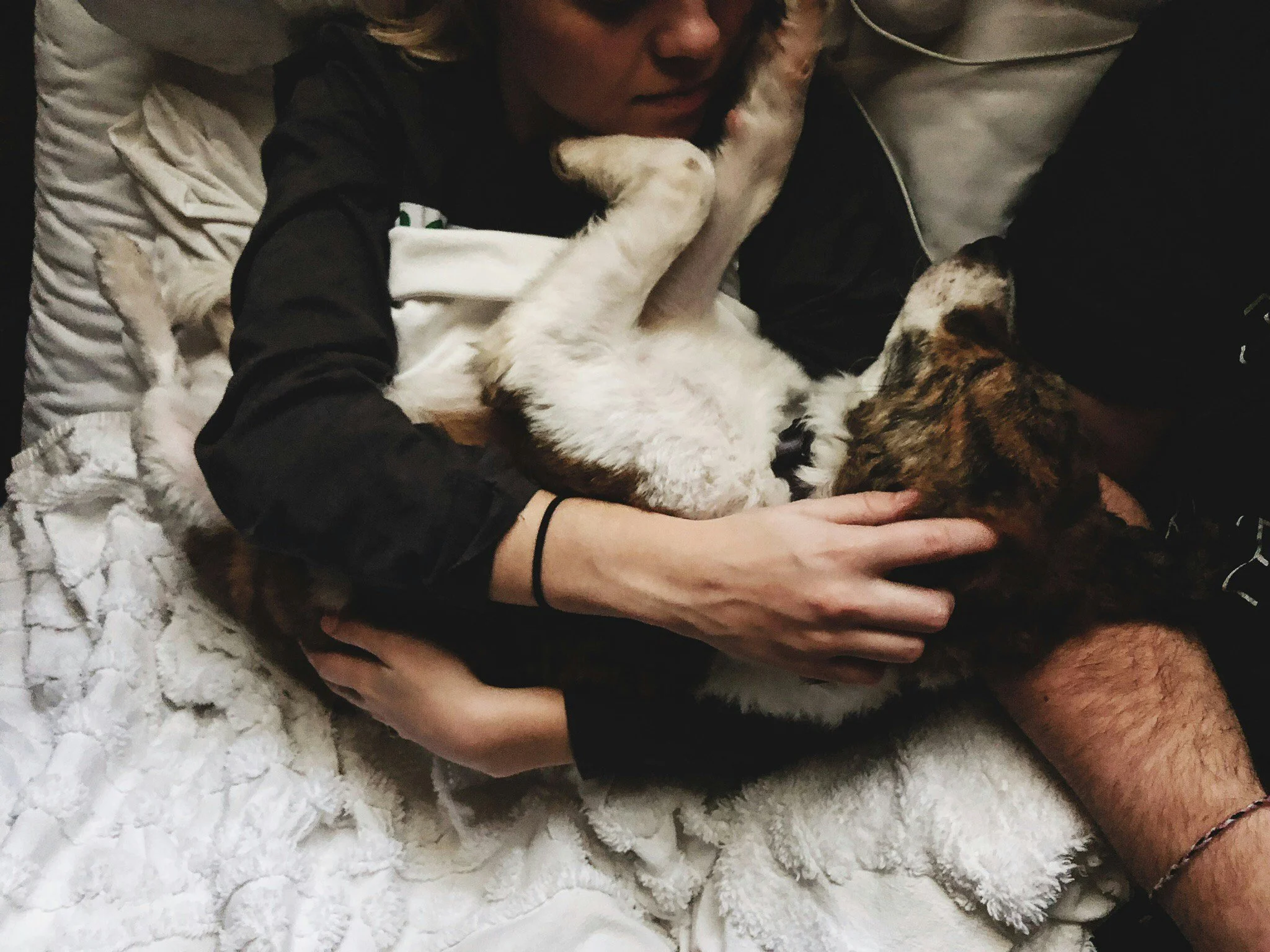
Your dog has learned to relax under certain strict conditions of closeness. Your job is to teach them to relax at greater distances and under more general conditions.
I want you to think about what the job actually is when it comes to fixing Separation Anxiety. Your dog can relax, but only if you are close. So the goal is for them to relax, at greater distances, or under more general conditions, for longer periods of time.
With this in mind. Do you think a smelly collar is going to teach your dog to relax when you aren’t as close? Do you think a licki-mat is going to do that job better, or at all? And do you believe that leaving and coming back a whole bunch of times in quick succession is going to teach your dog to relax if they weren’t relaxed (and no one taught them how to relax) when you left?
If we were translating this into Proximities terms, leaving and coming back is basically going from having a dog relaxing in your intimate space, to a dog definitely not relaxing in your public space - completely skipping over Personal Space (1 meter) and Social Space (5 meter) zones and just diving straight in at the deep end, with literally no teaching mechanism to address your dogs inability to practice relaxation alone. So the whole thing ends up like a really bad magic trick, except instead of making the separation anxiety disappear, your dog is just making pieces of your furniture disappear instead.
Your dog has also learned to follow you, wherever you go - and this is a habit that needs to change if they’re going to relax on their own.
Want a cup of tea? Have a dog assistant. Checking the postbox? Have a dog assistant.Need the toilet? Have a dog assistant. Dogs with True Separation Anxiety are stuck following you wherever you go, because they cannot relax without you.
If you want your dog to relax on their own, you first of all have to be able to ask them not to follow you. Until they know, and can respond to that request by relaxing on their own - they will follow you to every single door, and if they get stuck on the other side of it when you leave - they will put every ounce of their energy into trying to get through it and keep following you. And if that energy can’t open doors? it can be used to make a lot of noise, it can be used to destroy furniture, it can be used to pace and pant like crazy until you come back.
Small time increments aren’t real successes, and don’t count.
It’s worth being clear about this - measurements of seconds and single digit minutes do not count when it comes to success with separation anxiety. Dogs are smart, but they still need time to think and process whats going on before deciding what to do about it. So a dog that sees you coming in and out of the door a bunch of times is initially going to get confused, then stressed and fixated. Which means waiting for something to happen before practicing their usual behaviour pattern. I want to say this again, really clearly. They’re not learning anything, their behaviour isn’t changing - they’re waiting. Waiting is a really bad state of mind to leave a dog in - like a coiled spring. Because when they get fed up of waiting, they will do what they have always done when they get anxious, and you will have wasted months thinking you were getting somewhere when you weren’t.
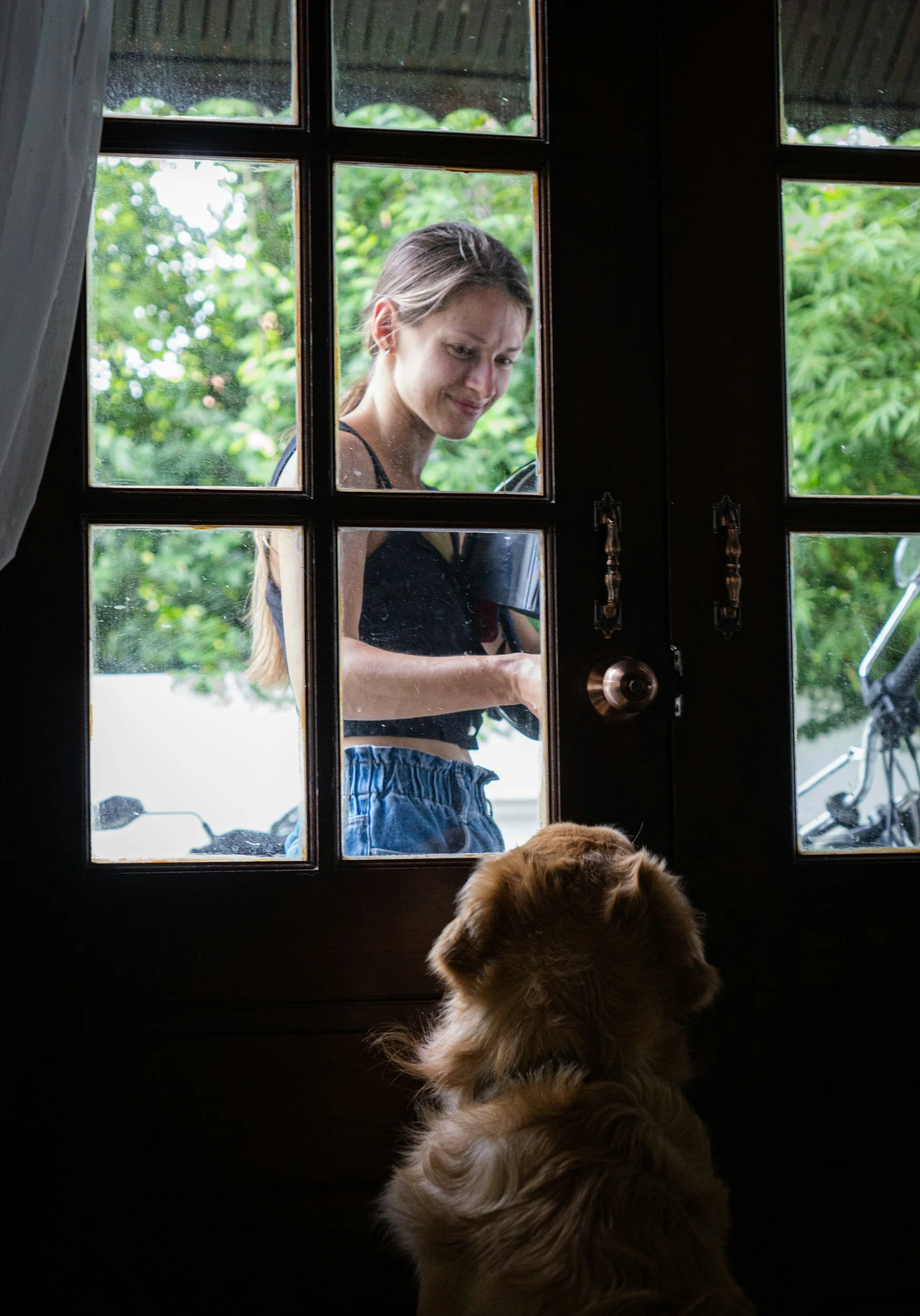
Small distance increments are real successes, and do count.
So if time increments don’t count, why do distance increments matter? In simple terms - because a dog choosing to give you space and not follow you is an observably different behaviour, and a different choice, to a dog that is following you to the door and then staring at it waiting for you to come back.
Want to go make a cup of tea? No problem - they’ll be on their bed waiting for you to come back. Want to take a shower in peace? No problem - they can handle it. Going to take the bins out? they’ll just chill on the sofa until you’re done. And all of those are great examples of dogs relaxing in social space - not in your intimate or personal space.
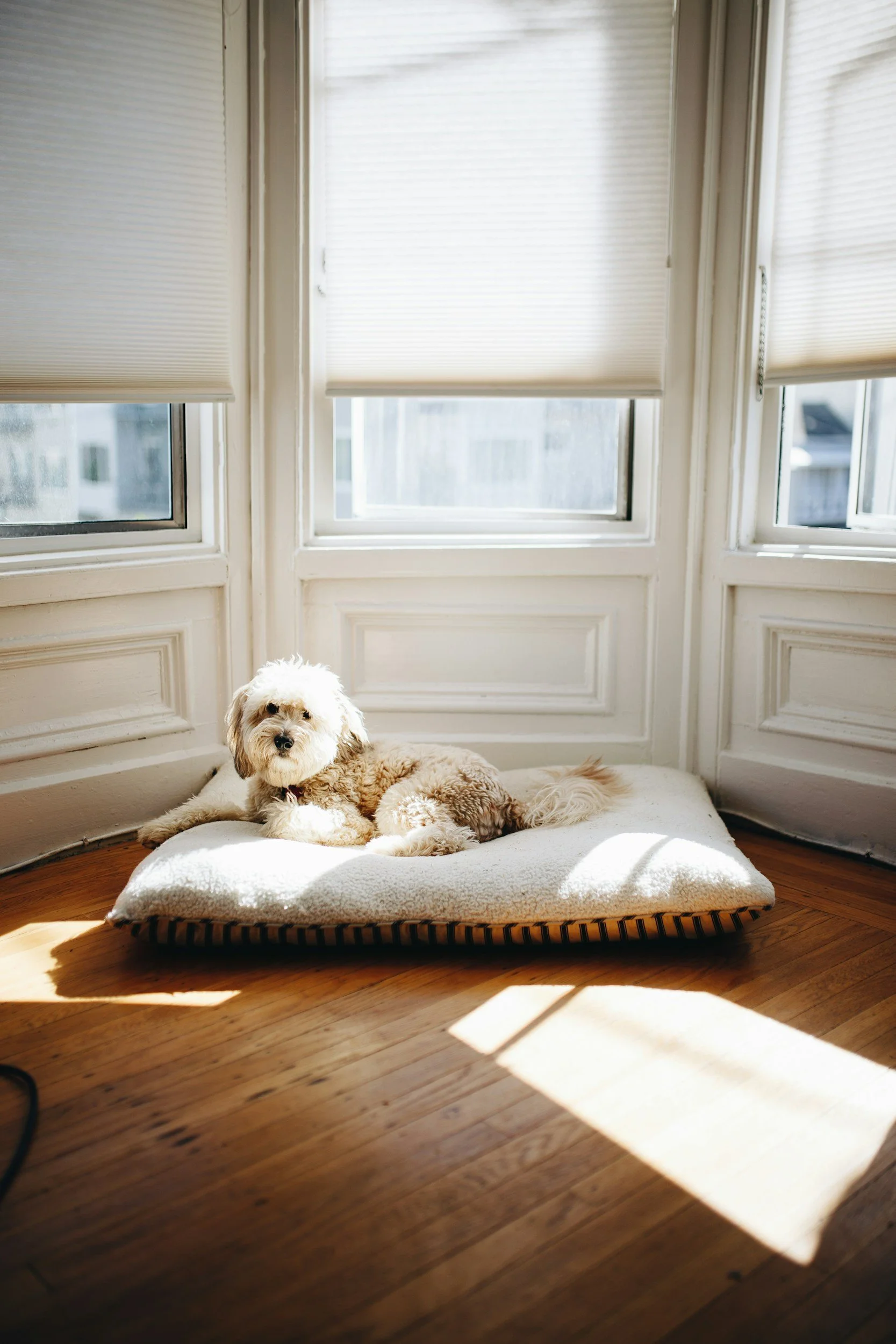
Independent Sleep - the big Win.
One of the biggest components of my Separation Anxiety Programme - and the one everyone asks, begs, pleads and complains about, is independent sleep. Or, to put it in Proximities Terms - a dog relaxing independently of you in public space, for a period of 8 hours.
It’s not a coincidence that pretty much ever client I have who’s dog has True Separation Anxiety sleeps on the bed or next to the bed. Of course they do - they can’t relax if they aren’t close. So how are they supposed to sleep if they aren’t close? And to make matters more complicated, many owners have deeper psychological attachments which put an added pressure on their dogs to be close to them at night.
But just like with children, Independence matters. Independent sleep - the confidence to be able to rest and manage your own space and safety without a parent next to you. Really, really matters for confidence and stress management. And when it comes to leaving dogs home alone, having the knowledge that your dog is happy to just sleep until you get back - is the best possible scenario when they are being left.
Independent Sleep gives you back real time.
I want you to also think about how the skill of sleep impacts on how long can be left alone - by thinking about time increments. It’s very easy to measure time through the lens of a linear countdown clock, whereby the longer your dog is left the more likely they are to get stressed.
The truth is - almost every dog I work with has about 30-45 minutes of patience to be left alone before they get stressed. it doesn’t sound like a lot. And it also doesn’t then make sense why my clients can leave their dogs alone for several hours. But here’s the secret - the clock isnt running when your dog is asleep. Which means that you don’t have a maximum of 45 minutes if your dog is left alone - you have 45 minutes + however long they’re happy to sleep for. And if your dog is used to sleeping alone for 8 hours every night, without issue - then they can definitely handle a couple of hours siesta in the afternoon whilst you go and run some errands. Thats the other reason why time is such a poor indicator of success - because it isn’t in itself an indication of a learned skill. Independent sleep - absolutely is.
My clients dogs learn to relax at distance. Yours should to.
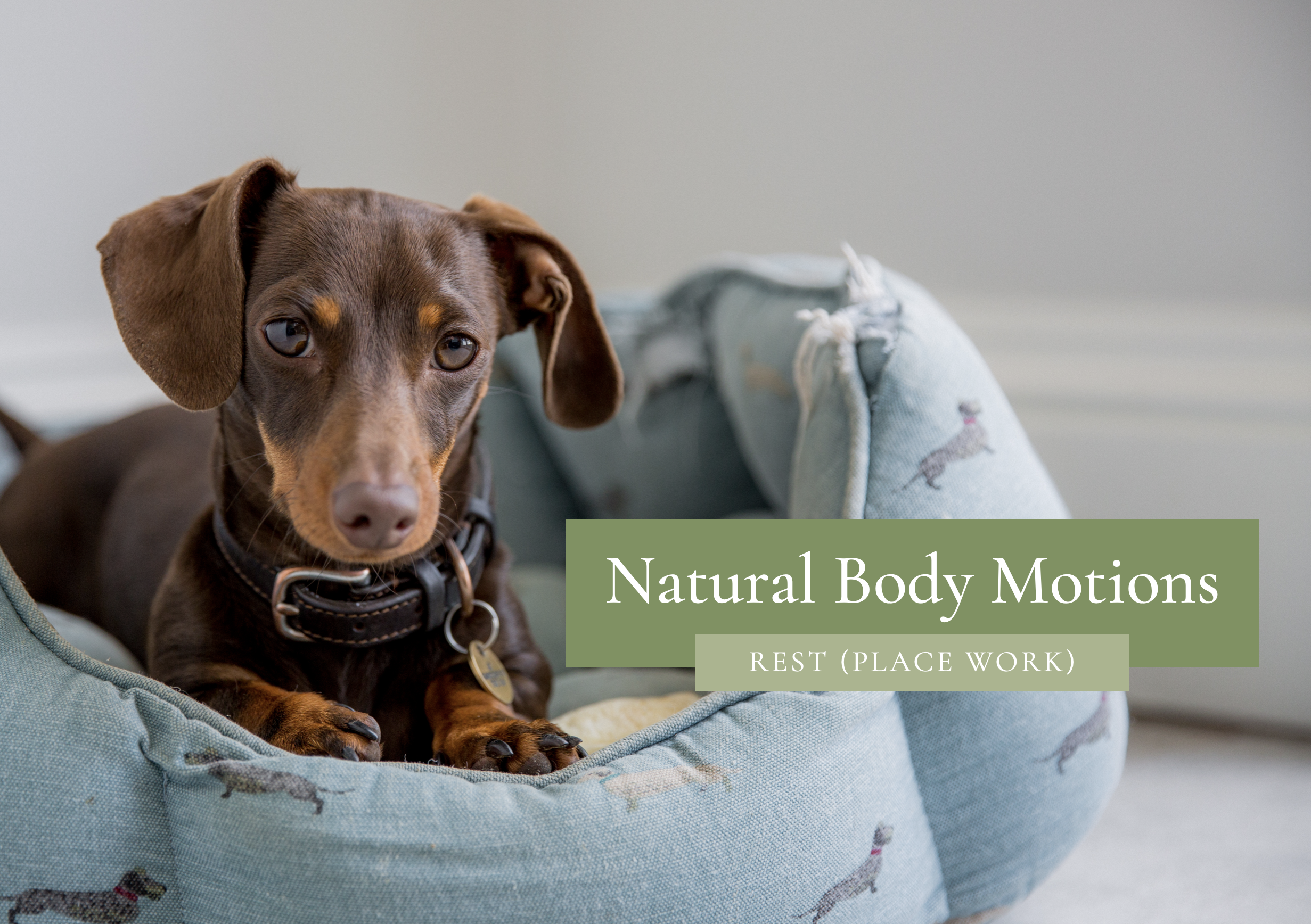
The first step for all of my clients whose dogs have True Separation Anxiety is to teach their dogs to relax on a dog bed whilst they move around the home. It’s an invaluable skill - it’s called place work. We have a video on it in our members library. It’s one of the most important skills my clients learn - and it’s a good one for your dog to learn too.
Relaxation Essentials - Videos for Members


In this video, we explore one of the most important concepts when it comes to our interactions with our dogs - Touch Imprint. Your dogs experience of touch, how it makes them feel - and how that determines all of your other interactions with them, as absolutely crucial to your relationship.
In this video, we explore one of the most important concepts when it comes to our interactions with our dogs - Touch Imprint. Your dogs experience of touch, how it makes them feel - and how that determines all of your other interactions with them, as absolutely crucial to your relationship.