
The Ultimate Supplement Comparison | Part 1 - Calming
Having just finished my 2026 Dog food review, I was talking to a client with a wonderful and intensely driven Springer Spaniel called Hector, and realised that it was worth wading into the wonderful world of dietary supplements. And wade I did! Because when it comes to supplement brands, ingredients, dosage and value - it’s extraordinarily difficult to know whether you are getting the right thing, and whether it’s doing any work.
Luckily - AI has arrived in the universe, and whilst I doubt it will ever replace dog training, it’s certainly fantastic at crunching numbers, running the maths, and analysis of the scientific research. So, thanks to Claude, we have a funky interactive table that allows us to do a full comparison of the brands, before I give my personal recommendations.
Here’s how it works.
I have collected the data from 8 brands that sell calming supplements in the UK - and with the help of AI converted them into a comparison table, broken down by the key categories or “systems” for calming dogs down. We have looked at the amount of each ingredient per dose, and we have also looked at the “value” by calculating the equivalent dose for the same amount of money. What that means, is that if brand A sold a tablet with 50mg of tryptophan for £1, and brand B sold a tablet with 20mg of tryptophan for £0.50, the better value brand would be brand A because £1 worth of Brand B would only give you 40mg of tryptophan, not 50mg. Playing with dosage is one of the main ways that a brand can make something look like its better value than it is, because they can claim each tablet has more active ingredients in - but you may also be paying an awful lot more per tablet.
What AI has helped with, and what it hasn’t.
Unfortunately for you, the writing and recommendations are all me. I’m the only one doing the comparisons, looking at the numbers, organising the categories and double checking the weightings. So when it comes to my recommendations - they’re all me. Where AI has helped is with coding the table in a way that makes it much easier to compare like for like in a number of different ways, converting per kg weights into per dose for the same size of dog, and by directly verifying for each ingredient what the current academic research tells us, so that it can be properly categorised. Thats helped with decisions like identifying herbal extracts with wildly variable amounts of active ingredients, so that they arent compared like for like to direct active ingredient values. By using AI to crawl through the academic literature, it makes it much easier for us to put in an ingredient in a category where it has a known effect on the body.
Efficacy and our Recommendations
Once you’ve had a good play through with the data, we’ll be giving our recommendations, based not just on the best value products, but also on a discussion of how much of this stuff actually works. One thing that this interactive table should make obvious, is that there are awful lot of different ingredients being used by a lot of different brands, presented in very different ways to make it REALLY confusing for consumers to know what’s what.
Calming Supplement Comparison
Declared active ingredients across eight UK dog calming supplements, dosed for a 30kg dog. Switch between raw dose and value for money.
Showing declared dose per day at the 30kg feeding rate for each product.
| Ingredient |
|---|
Scroll to see more brands
Cost/day is calculated from standard UK one-off retail pricing at time of writing, not subscription discounts, and will drift as prices change — treat as illustrative, not exact.
Value view (£) divides each declared dose by that product's cost/day. It highlights which product delivers most of a given ingredient per pound spent, not which formula is "better" — a cheap product with a small dose can still out-value an expensive one with a larger dose.
Zylkene's alpha-casozepine figure is the weight of the hydrolysed milk protein carrier, not isolated active peptide. Vet Spec's magnesium is declared as magnesium sulphate (a compound), not elemental magnesium — the hydration form isn't stated on the label, so an elemental-Mg figure can't be derived. Pooch & Mutt's tryptophan dose is a range (7–10 chews/day per the label's weight band); the value view uses the midpoint.
Gaps in the table reflect what each label actually declares — they are not evidence the ingredient is absent, only that no quantity is stated.
Gut-brain axis mixes probiotic CFU counts, an unquantified prebiotic, and a milligram amount — units too different to sum or compare by size. Vet Spec, Daily Calm, and NutriPaw (the three brands with any declared ingredient here) rank equally rather than being ordered against each other, and per-row "best value" badges are switched off in this category for the same reason.
Other (L-Arginine and Inositol) is treated the same way as Gut-brain axis — YuMOVE and Rapid Calm rank equally rather than having their two unrelated compounds compared by size. Unlike Gut-brain axis, this category also counts for half the weight of a normal category when combined with others in the multi-select ranking: both ingredients have genuine, single-compound evidence behind them, but each brand's entry here is a single extra ingredient added to a formula built around something else, so it shouldn't sway an "overall" comparison as much as a full category would.
Rosmarinic acid (5.25mg) is calculated directly from Rapid Calm's own label, which standardizes its lemon balm to "5% rosmarinic acid" — 105mg × 5% = 5.25mg of the actual active compound. This is the only whole-herb ingredient in the table with enough label information to calculate a genuine active-compound figure. Every other herbal extract (valerian, chamomile, scullcap, passionflower, GABA fermentate blend, green tea, hemp) is declared only as raw extract weight with no stated standardization, so the mg shown is bulk extract, not active-compound content — published ranges for how much active compound a "typical" extract like this contains can vary more than 10–50× between products. Because of that, ranking within "Herbal extracts" is a herb-to-herb comparison of declared bulk weight, not a claim about actual active-compound potency — if it's combined with other categories via the multi-select tool, only its rank position (1st, 2nd, 3rd…) carries over into the average, never its raw mg, so it can't be added directly to figures like tryptophan or magnesium. Mistletoe, gentian, ginger, and fish protein hydrolysate sit in their own "no documented calming mechanism" category and aren't ranked at all, for the separate reason that the published research doesn't support them having a calming mechanism in the first place.
The Results and My Recommendations
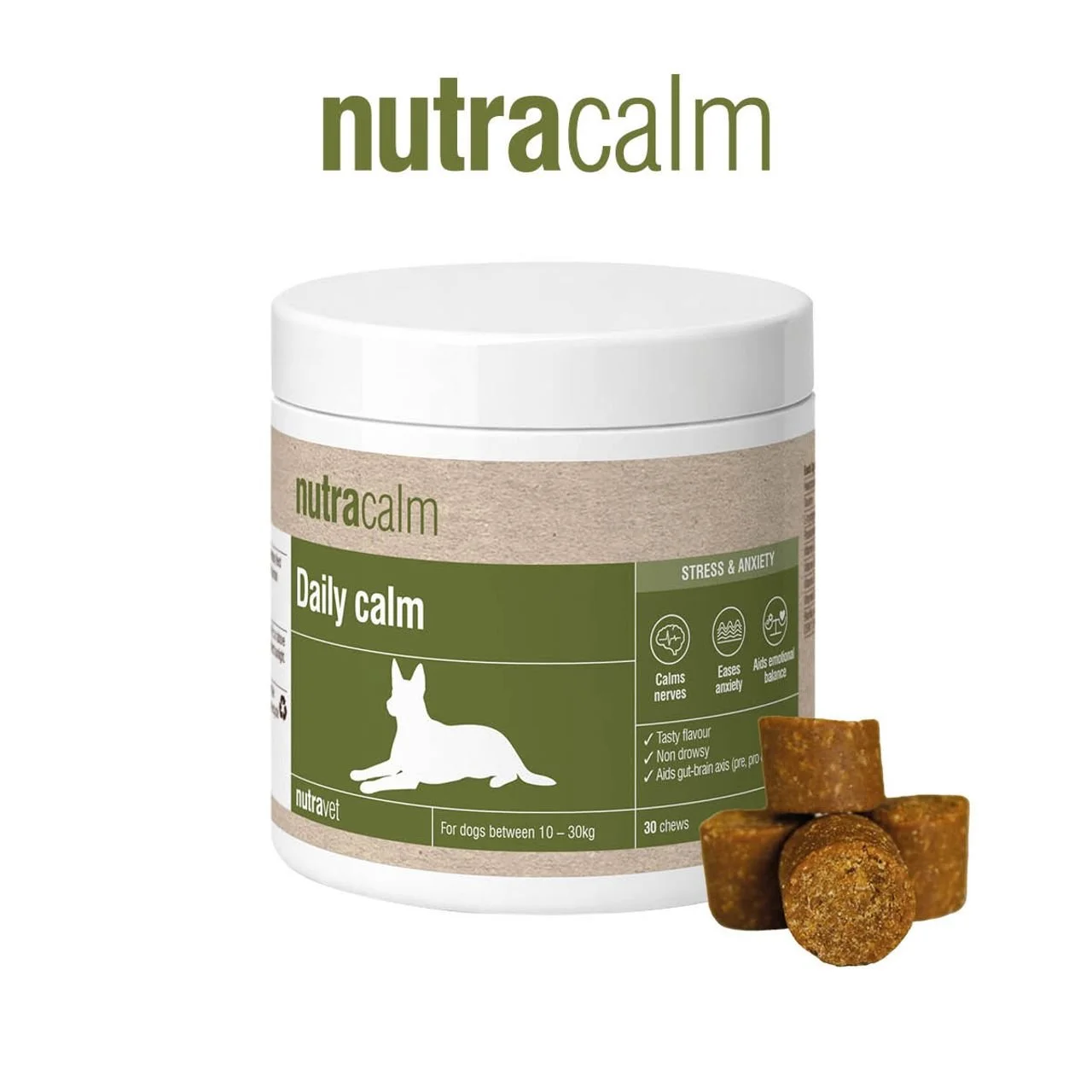
Best "All-Rounder” - Daily Calm by Nutravet.
Nutracalm is the supplement I use with my youngest spaniel Luca, to help with his Canine Compulsive Disorder. He isn’t an anxious dog - but he becomes overstimulated very easily, compulsively runs (as in 3 hours at full speed without stopping), spins, and compulsively drinks in excess. This stuff, combined with structure, training, and a lot of exercise, makes for a much easier life.
When it comes to finding a supplement thats actually going to help your dog relax, being able to hit multiple different areas at once, based on different areas of scientific research, can really help. Daily Calm certainly isn’t the strongest in every single category, but where it excels is that it has touch points in 5 different areas. It uses Taurine as a GABAergic modulator, L Tryptophan as a Serotonin precursor, Passionflower which is also recognised for its GABAergic interactions, a wide range of Vitamin B co factors, and B.velensis probiotic strains for work on the gut brain axis.
This is one of those products where being a jack of all trades isn’t a bad thing, because for most dogs it’s highly unlikely to be one single thing in a dogs diet, or one single component of their health and genetics that needs addressing.
From a value proposition, Daily Calm works out at £1.00 per day for a 30kg dog, and sits in the ‘middle of the pack’ (couldn’t help it) for price. Not the cheapest on its own, but compared to buying 2 or 3 different supplements, knowing that Daily calm hits 5 different areas is where it’s value shines through, and why it’s my pick for Best All Rounder.
Best "Big Hitter” - YuMove Calming Support
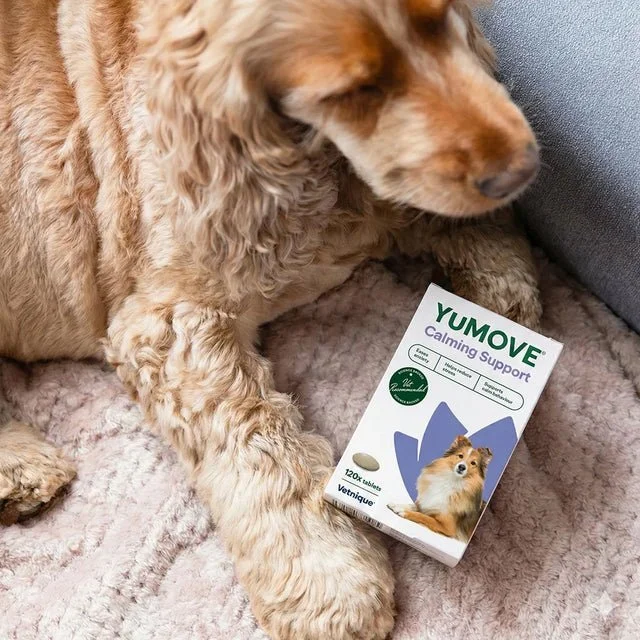
When it comes to the boxes that any calming supplement wants to tick, the big two are GABA, and Serotonin. The UK government recently removed GABA from the supplements list - don’t ask me why - because it’s well recognised as a neurotransmitter with well documented calming effects on the brain and Body. Which means a lot of supplement manufacturers now use GABAergic modulators - other substances that interact with and promote GABA, in order to encourage GABA production when they can’t put it directly into their supplements. The way YuMove has approached this is with a fementate blend - a way of using bacteria to digest Glutamate and make GABA as a byproduct. YuMove also uses lemon balm extract - and when it comes Serotonin, YuMove contains a very enthusiastic amount of L tryptophan, and L Arginine, and B Vitamins. It doesn’t do anything on the gut brain axis, and it doesn’t contain a lot of other typically included calming herbs - but you know that it is ticking the big boxes where it counts, in an obvious, directly targeted fashion.
YuMove also comes out at £1.07 per dose for a 30kg dog, with some chunky subscription discounts - and is actually the best value in mg/£ for 4 of the ingredients it contains.
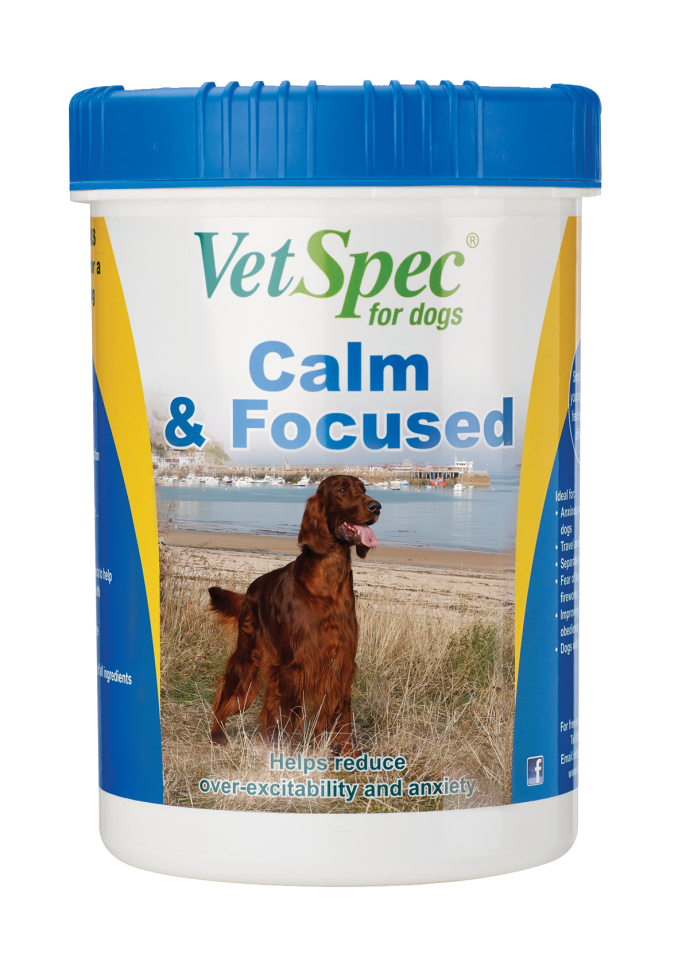
Best Value Option - Vet Spec Calm & Focused
If you’re looking at getting the best bang for your buck, based on those same two targets of GABA and Serotonin, and with the added benefit of bacteria for the Gut Brain Axis then VetSpec is going to be your best option. It offers the same amount of L Tryptophan as Nutravet Daily Calm, for a fraction of the price, and when compared to YuMove, works out cheaper for the same equivalent dose. It also contains an enthusiastic dose of Magnesium - magnesium being one of the most basic and fundamental ions for both preventing excitatory NMDA signals and encouraging calming GABA-A ones.
Vet spec comes in at just £0.28 per dose for a 30kg dog, making it by far one of the most affordable supplements on the market. And the fact that it has a short ingredient list (no real space for extra herbs, vitamins or minerals), and the more obvious fact that it’s a little known, unadvertised product also goes some way to explaining why that price differentiator exists. You’re paying for essentials that work, nothing else.
A final note on the Scientific literature.
I asked Claude to look at the ingredients from a point of view of efficacy - looking at what the scientific literature says about how much of this stuff actually works - and this was the feedback:
“I went through the published research behind every ingredient in this comparison, and here's the uncomfortable truth: almost nothing here is as settled as the marketing suggests. The ingredient with the strongest dog-specific evidence I found — L-theanine — doesn't appear as a declared, dosed ingredient in any of the eight products; it's only present, unquantified, inside one product's green tea extract. Meanwhile tryptophan, the ingredient nearly every "calming" formula leans on, produced mixed-to-negative results in the small number of controlled dog studies that actually exist. And valerian — dosed at 1500mg in one product, more than any other single ingredient in this whole comparison — has never been tested in a dog-specific clinical trial at all. Not a weak result. No result.
That's not the same as saying nothing here works. Several ingredients — chamomile, scullcap, passionflower, magnesium, alpha-casozepine — have real, published pharmacology behind them: documented receptor-level mechanisms, not marketing invention. Passionflower's case is genuinely solid, with a study showing its calming effect could be switched off by blocking the exact receptor site it's meant to act on. The catch is that almost none of these ingredients are declared with any indication of potency or standardisation — a label saying "valerian root extract 1500mg" tells you almost nothing about how much of the actual active compound that contains, and published ranges for herbs like this can vary by 10 to 50 times between products. So even where the mechanism is real, most labels don't give you enough information to judge whether that specific product delivers a meaningful dose of it. My honest summary: the mechanisms are frequently genuine, the dog-specific proof is mostly thin or missing, and the dosing transparency needed to judge any individual product is, for almost everything except tryptophan and rosmarinic acid, simply not there.”
Claude raises a really important point when it comes to calming supplements, and the wider supplement industry in general. Which is that there is a big gap between the claims as to what works, and the evidence to back it up. Ultimately when it comes to scientific research, it requires a big cash injection to do proper quality analysis and get meaningful results, and the reality is that there would be no real financial incentive for most supplement companies to prove (or disprove) their products beyond what is already available. We are somewhat reliant both on the existing research to make guesses around efficacy, and dependent on the honesty of the manufacturers that they are using quality ingredients with high levels of active ingredients in their recipes.
Ultimately, any supplement is going to be a cherry on the cake compared to fundamentals such as proper exercise, training and behaviour work. Time, patience and relationship building will in my opinion do more than any supplement.
